

The cloud has become a central pillar of modern IT strategies and is moving increasingly into focus for organisations of all sizes. The decision to embark on the journey into the cloud is no longer a purely technical matter. It is a strategic one. While some organisations pursue a strict cloud first approach, others deliberately combine existing systems with modern cloud services, following a hybrid cloud model. The practical examples of Rosenxt and Q1 Energie show that success in the cloud does not depend on the strategy alone but on how well the chosen approach aligns with the organisation itself.
Cloud First Strategy vs Hybrid Cloud
What does Cloud First mean?
A cloud first strategy means that an organisation prioritises the use of cloud-based solutions. Applications are either operated directly in the cloud or are planned to be migrated there in the future. The aim is to achieve high scalability, greater flexibility and a modern digital infrastructure.
What do we mean by a Hybrid Cloud?
A hybrid cloud approach combines on-premises IT infrastructure with cloud services. Organisations decide individually which applications should run in the cloud and which remain on site. This approach provides flexibility to meet specific requirements and enables a gradual transformation at the organisation’s own pace.
Different Starting Points at Rosenxt and Q1 Energie
During an interview at the d.velop SUMMIT, Katharina Bandow (Product Owner at Rosenxt Holding AG) and Christoph Jülich (Project Manager at Q1 Energie AG) shared their experiences with the d.velop platform. Rosenxt opted for a cloud first strategy to respond more flexibly to market demands and to fully embrace digital transformation from the outset. Q1 Energie, on the other hand, follows a hybrid cloud approach because its existing ERP systems are not cloud-compatible and in-house IT administrators manage the systems. The hybrid cloud strategy allows individual modules to run in the cloud while others remain on premises.
Rosenxt – Cloud First with an International Focus
Rosenxt is a technology-driven start-up with around 500 employees, founded in 2023 as a spin-off of the ROSEN Group. The company develops cutting-edge solutions for industrial plants and critical infrastructure, including autonomous water sports equipment, AI-based inspection systems and intelligent materials. With locations in Vietnam, the USA, Canada, England, Switzerland and the Netherlands, Rosenxt operates on an international scale.
The decision to adopt a cloud first strategy was a deliberate one. As a young and rapidly growing organisation (expected to reach 700 employees by the end of 2025), scalability was a key criterion. Digital transformation was not seen as a later adjustment but as an integral part of the corporate structure. Starting on a “greenfield” basis allowed the company to rethink its IT systems from the ground up. This created conceptual challenges but also offered significant freedom.
Rosenxt began with d.velop documents and d.velop invoices. The automated invoice recognition delivered immediate, measurable benefits: in the first month alone, 58 hours of working time were saved. Additional modules such as process management, contract management and quality management are currently being implemented.
The cloud first strategy enabled a fast and flexible rollout. The main challenges lay in the conceptual groundwork, as requirements sometimes had to be adjusted in an agile manner.
Our invoice volume has become far more manageable, and that was evident in the very first month. We had already saved 58 hours.
Katharina Bandow, Product Owner, Rosenxt Holding AG
Q1 Energie – Hybrid Cloud for the Mid-Sized Sector
Q1 Energie is a medium-sized filling station operator with around 230 sites across Germany. The industry is undergoing significant change, with electromobility, digitalisation and new business models such as AI-supported smart shops shaping the future. Q1 is responding with strong innovative drive while remaining committed to its established IT landscape.
The decision to adopt a hybrid cloud approach is based on practical considerations. The existing ERP system is not fully cloud-compatible, and in-house IT administrators maintain the infrastructure. The hybrid cloud strategy makes it possible to run individual modules such as contract management or invoice recognition in the cloud while keeping others on premises. This ensures flexibility and supports a gradual transformation.
Q1 has been using the platform since 2017 and consciously chose a hybrid cloud architecture. The integration of third-party providers for digital signatures demonstrates the openness of the d.velop platform. The company particularly values the ease of implementation: a module can be activated with a single click and integrated into the existing infrastructure without users noticing major changes.
Automatic updates, improved software standardisation and better document findability offer further advantages. User acceptance and the involvement of key users were central success factors in the project. In addition, digital contract management saves time and increases transparency.
What will certainly be interesting is the d.velop pilot, which is now also included as a standard feature on the platform.
Christoph Jülich, Project Manager, Q1 Energie AG
Myths Debunked by Rosenxt
- “The cloud is insecure” – Katharina Bandow from Rosenxt emphasises that cloud providers are often better equipped to meet security requirements than internal IT departments. She points to the high compliance standards and the providers’ obligation to demonstrate excellence in security. Her conclusion: “The cloud can be more secure than on-premises solutions.”
- “Cloud means losing control” – Rosenxt shows that a cloud first strategy does not automatically mean cloud only. Critical systems can still be operated locally if necessary. The decision remains with the organisation.
- “The cloud is only suitable for large corporations” – As a fast-growing start-up, Rosenxt deliberately uses the cloud to scale flexibly and to integrate new international locations. This is clear evidence that cloud strategies offer major advantages for young companies as well.
Myths Debunked by Q1 Energie
- “Hybrid cloud is complicated and expensive” – Christoph Jülich explains that switching to hybrid cloud services with d.velop was extremely straightforward – often a single click is enough. Integration takes place seamlessly, without users noticing major changes.
- “The cloud is not compatible with existing systems” – Q1 demonstrates that even older ERP systems and bespoke in-house developments can be combined with cloud modules. The hybrid cloud strategy enables gradual modernisation.
- “Data protection cannot be ensured in the cloud” – Q1 highlights the possibility of concluding data processing agreements with cloud service providers and stresses that on-premises systems can also be insecure if they are poorly administered. “You can make just as much of a mess on premises as you can in the cloud,” Christoph Jülich points out.
The Individual Path into the Cloud
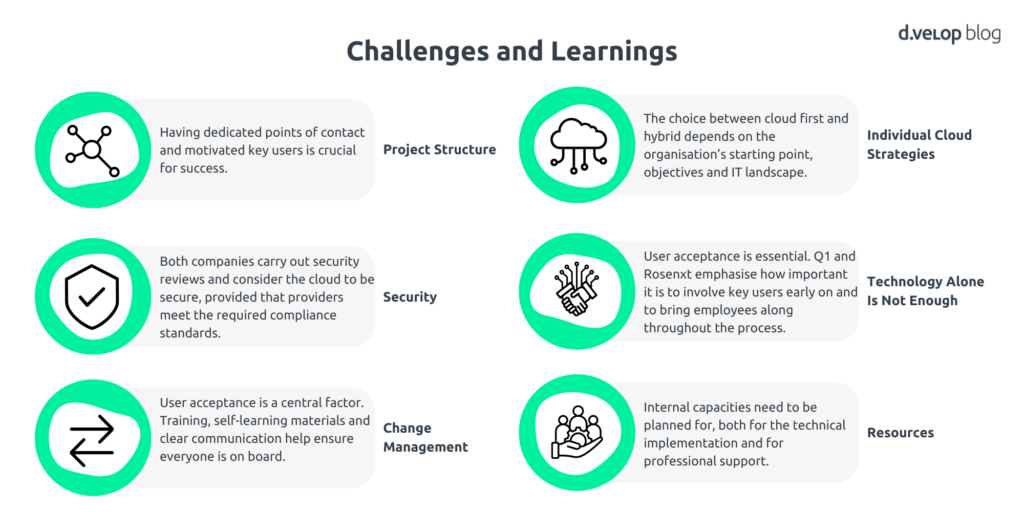
Whether a cloud first strategy or a hybrid cloud approach is chosen, every organisation must find its own path into the cloud. The decision depends on the starting point, requirements and objectives. What matters most is thoughtful planning and involving employees throughout the journey. In the end, it is not the technology itself that determines success but how well it is accepted.
The added value is already becoming clear. Rosenxt is benefiting from efficiency gains and is planning expansion to international sites as well as deeper integration into Rosenxt’s overall system landscape. Q1 Energie sees advantages in greater standardisation and intends to extend its workflows with the process studio and make use of the d.velop pilot for AI-supported assistance. The examples of Rosenxt and Q1 Energie demonstrate that both approaches can succeed, provided they align with the broader business strategy and are implemented consistently. They also emphasise an important point: the cloud is not an end in itself – it must create value and make work easier.