
The way companies issue and process invoices has fundamentally changed in recent years. Instead of printed paper invoices, digital documents are increasingly taking over financial administration. A key driver of this development is the mandatory introduction of electronic invoicing. While e‑invoicing has been required in public procurement for several years, the obligation for B2B transactions has also applied across the board since 1 January 2025.
But what exactly is meant by the term e‑invoicing, and how does an electronic invoice differ from a traditional paper invoice? What specific benefits does it offer to companies? How does the e‑invoice contribute to greater sustainability and transparency? And why is a PDF file not considered an electronic invoice?
In this blog article, we answer all these questions and provide you with a comprehensive overview of the topic of e‑invoicing.
What is E-invoicing?
E‑invoicing (electronic invoicing) refers to the exchange of invoice data between business partners in a structured, electronic format that enables automated processing. It covers all steps from the creation and transmission to the processing and archiving of invoices.
What is an E‑Invoice?
An e‑invoice (electronic invoice) consists of structured electronic information that is automatically readable by machines. For humans, this data is not directly understandable without further processing. In Germany, invoice data is currently transmitted either directly between the parties involved—e.g., by e‑mail—or via specialised e‑invoicing networks such as PEPPOL.
A distinction is generally made between outgoing invoices (accounts receivable) and incoming invoices (accounts payable). For accounts‑receivable invoices – those sent to a company’s customers – the e‑invoice is either generated directly within the ERP or accounting system, or specialised e‑invoicing providers are used. These providers create the e‑invoice based on the invoice data and then send it via the desired channel (e.g. e‑mail, PEPPOL). The latter offers the advantage that dedicated e‑invoice software typically supports all relevant standards, and e‑invoicing providers can advise companies on the various requirements and formats. Accounts‑payable invoices, on the other hand, are received from suppliers, for example following a purchase order. If these are submitted in electronic form, the company requires suitable e‑invoice software to process the electronic invoice data.
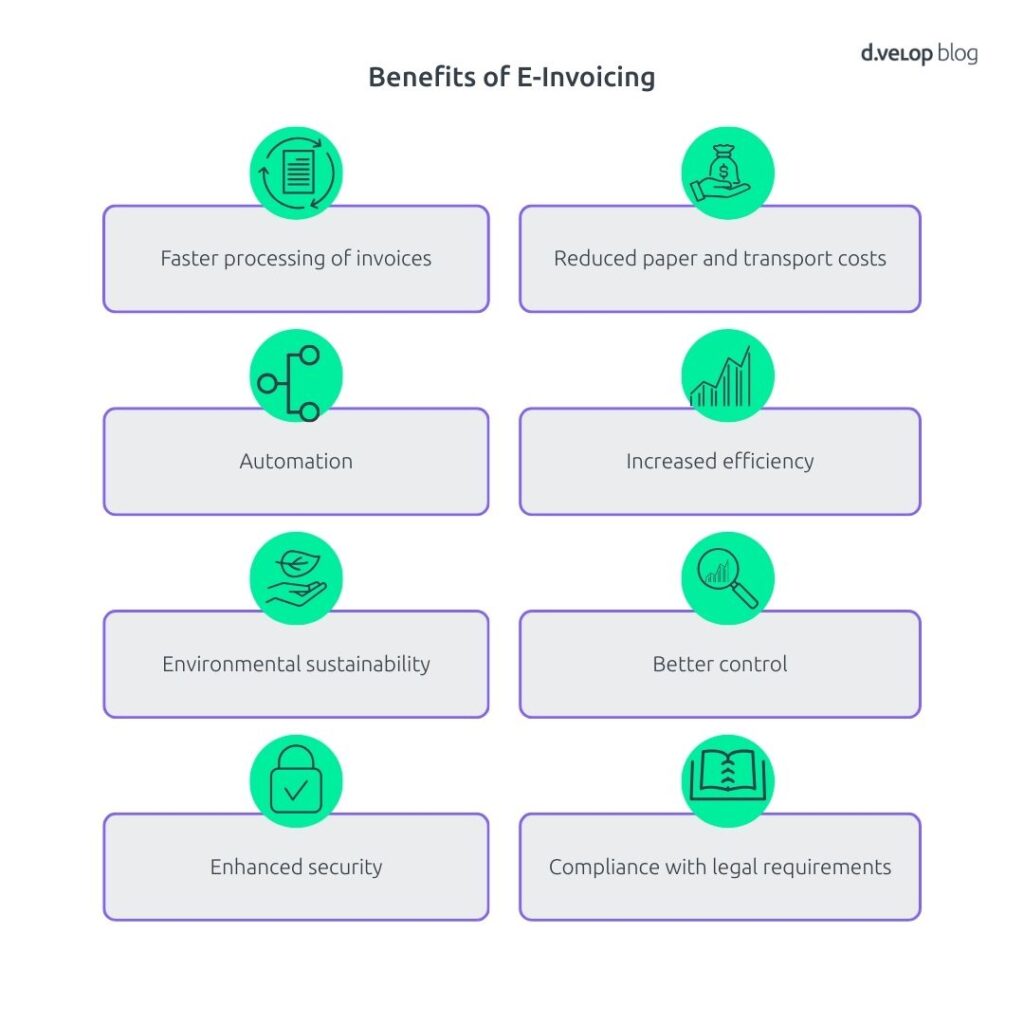
What are the benefits of E‑Invoicing?
The introduction of e‑invoicing offers numerous advantages. After adapting internal processes once, you can expect significantly fewer errors, noticeable time and cost savings, greater transparency, and improved cash‑flow management. Additionally, the digital process simplifies compliance and contributes to greater sustainability by eliminating paper‑based procedures.
Error reduction
With electronic invoice formats such as the XRechnung, the error rate decreases significantly because all information is transmitted and read digitally in a structured form without any loss of quality.
Time and cost savings
Because time‑consuming manual checks and data entry are no longer required, employees save a considerable amount of time. The much lower error rate also results in fewer queries and rework, further reducing workload. Overall, this leads to significant cost advantages for the company.
Transparency
Digital invoice processing makes it much easier to track the status of individual invoices, as all process steps are documented transparently. Electronic or digitally captured invoices are stored centrally and are available at any time in one place—unlike scattered paper documents in unstructured physical archives.
Cash‑flow management
Improved insights into invoice status accelerate payment processes because companies always have up‑to‑date information. This real‑time transparency also allows companies to recognise potential liquidity bottlenecks early and take appropriate countermeasures.
Compliance
Electronic invoicing ensures seamless and legally compliant documentation of all transactions. Every step in the e‑invoicing process—from creation to archiving—can be traced and controlled. This simplifies audits and supports compliance with accounting and tax regulations.
Sustainability
Digital invoice processing significantly reduces paper consumption. This helps protect the environment, as the production, transport and disposal of paper are eliminated.
The legislator as an “Early Adopter” in the field of E‑Invoicing
The EU Directive 2014/55/EU obliges public contracting authorities to be able to receive electronic invoices. Since 2020, suppliers to public institutions in Germany have also been required to submit their invoices electronically – meaning that e‑invoicing has already been mandatory in the B2G sector for several years.
With the initiative “VAT in the Digital Age” (ViDA), the EU is planning to extend the obligation to issue electronic invoices to the B2B sector, partly in order to combat VAT fraud. In Germany, this was implemented through the Growth Opportunities Act: since 1 January 2025, companies of all sizes must be able to receive, process and securely archive electronic invoices in a compliant manner.
What counts as an E‑Invoice?
Invoices can generally be categorised into unstructured, hybrid and structured data formats:
Unstructured data
Files such as PDFs, TIFs, JPEGs, Word documents or e‑mail texts are considered unstructured data. For example, if you receive an invoice as a PDF or scan a paper invoice, this does not constitute a true electronic invoice, as the data is not machine‑readable. Consequently, PDF files do not qualify as electronic invoices and may no longer be issued from 1 January 2027, or 1 January 2028 for smaller companies.
Hybrid invoice formats
Hybrid invoices combine a human‑readable component, such as a PDF document, with a machine‑readable, structured component. A well‑known example is the ZUGFeRD format.. It is important to note that only the data contained in the structured part is legally binding and may be further processed.
Structured data
Invoices such as “XRechnung” (Germany’s B2G e-invoice standard) consist exclusively of structured XML data. These machine‑readable details are hardly understandable to humans without specialised software, yet they contain all relevant invoice information in a precise format.
E‑Invoice software with integration capabilities
d.velop offers solutions for processing incoming e‑invoices in combination with a wide variety of ERP systems, such as SAP, Microsoft Dynamics or Microsoft 365. Various electronic invoice formats can be read automatically. For fully structured formats such as XRechnung, a PDF file is generated from the structured data to provide a clearer visual comparison during the invoice verification and approval process. Once the e‑invoice has been approved, the posting is either triggered directly in the ERP or accounting system, depending on the configuration, or a posting proposal is transferred to the downstream system for further processing.
Automated invoice processing – a must‑have!
Due to the mandatory introduction of electronic invoicing, which has been gradually implemented since 1 January 2025, as well as the numerous advantages that speak in favour of automated invoice processing, the topic of e‑invoices is virtually unavoidable. Companies that address this topic at an early stage position themselves for a future‑oriented and efficient administration of their processes.
Questions About E‑Invoicing
What is E‑Invoicing?
E‑Invoicing (electronic invoicing) is the process in which invoices are created, transmitted and processed electronically rather than on paper.
What is an E‑Invoice?
E‑Invoices contain electronic data that can only be read by computers. The human eye cannot interpret this data without conversion or visualisation.
What are the benefits of E‑Invoicing?
E‑invoicing offers numerous advantages, including faster invoice processing, cost savings, automation, increased efficiency, environmental sustainability, improved control, enhanced security and compliance with legal requirements.
Is E‑Invoicing secure?
Yes, E‑Invoicing is more secure than paper‑based invoicing. Electronic invoices can be encrypted and digitally signed to ensure authenticity.
Contract management at its best
7 facts about contract management with Microsoft 365