

Improving contract management processes? A goal for every executive. Contract inefficiencies are not only time-consuming but also costly. A study by the World Commerce & Contracting Institute involving over 1,200 companies identified more than 40 conflict points throughout the contract management process that lead to value loss and financial setbacks. For example, the total costs for contract execution and associated value losses account for 2–4% of revenue in an average consumer goods company. In industries with high-value investment projects, such as construction or aviation, this share rises to over 15%.
The good news: companies that adopt contract management software early can minimise these losses. In the study, 65% of respondents reported investing in contract management technologies to enable employees to work more efficiently, reduce risks such as missed deadlines, and achieve better financial results.
This blog article explains exactly how the contract management process works and how it can be improved through digitalisation.
Control your contracts, control your business!
Contracts form the foundation of nearly all business relationships – from suppliers to customers to partners. Without clear structures and automated workflows, deadlines can be missed, compliance breaches may occur, and unnecessary costs can arise due to inefficient manual processes. Professional contract management ensures centralised access, better control over contract content, and faster decision-making. It also allows for thorough analysis of contract data to identify strategic opportunities and realise cost savings. In short: companies that have their contracts under control run their business more efficiently, securely, and sustainably.
It is therefore highly recommended to continuously improve contract management through the following steps:
- Drafting the contract
- Negotiating the contract
- Reviewing the contract
- Approving the contract
- Signing the contract
- Managing the contract
- Archiving the contract
How a contract management process works
Effective contract management supports all phases of a contract’s lifecycle, from initiating a business relationship to implementation, administration, and final archiving.

1. Initiating the Contract
The contract management process begins with the initiation of a contractual relationship. Once two parties start discussions, all relevant information – such as a draft contract and contact persons at a customer or supplier – should be compiled in a single file. This creates transparency, and every employee has an overview of all relevant information from the very start of the business relationship.
2. Drafting and Negotiating the Contract
Once a business relationship develops, the next step is drafting the contract. Contract management software allows companies to access centralised templates, enabling faster preparation of contract drafts. Multiple rounds of negotiation are often required before final signature, during which the contract draft and its content are discussed. In a centralised contract management system, all changes to the draft can be tracked using version history.
3. Reviewing and 4. Approving the Contract
After drafting and negotiation, the contract is reviewed and approved. This can be a multi-step process involving employees and managers from different departments. In a digital contract management process, these review steps are managed through workflows. The advantage is that workflows record who approved or commented on a contract at each stage.
5. Signing the Contract
Next comes contract signing. The approved document is sent to the contracting party, and the signed contract is stored in the relevant contract file. Using a centralised contract management system ensures that all departments always have the same information about the contract’s status and current version.
Why you should use digital signatures in contract maanagement
Digital signatures reduce costs and effort while offering additional benefits:
- Work paperless: save on printing and postage
- Increase efficiency: faster contract completion without media breaks
- Stay flexible: sign contracts anytime, anywhere
- Ensure legal compliance: eIDAS and GDPR-compliant
- Promote sustainability: save resources and protect the environment
Digital signing is therefore a key success factor for modern organisations.
6. Managing Contracts
Once contracts have been finalised and entered into the contract management system, managing them becomes highly important for any organisation. A key element of effective contract management is deadline management, which ensures that no deadlines are missed. With timely notifications, contracts can either be terminated in good time or terms renegotiated. Furthermore, a contract management system in which all contracts are stored centrally helps maintain an ongoing overview of the costs arising from contractual obligations.
7. Archiving Contracts
The final step in the contract management process involves archiving. In a high-quality contract management system, predefined rules ensure that contracts and business-critical information – once statutory retention periods have expired – are either automatically deleted or permanently archived, depending on their content. This removes the need for responsible employees to set manual reminders. It also reduces the risk of contracts becoming untraceable at a later stage.
Collaborative Contract Lifecycle Management for Microsoft 365
Learn in the webinar what digital contract management with Microsoft 365 looks like and how you can benefit.
Contract administration vs Contract management – What should organisations prioritise in the contract management process?
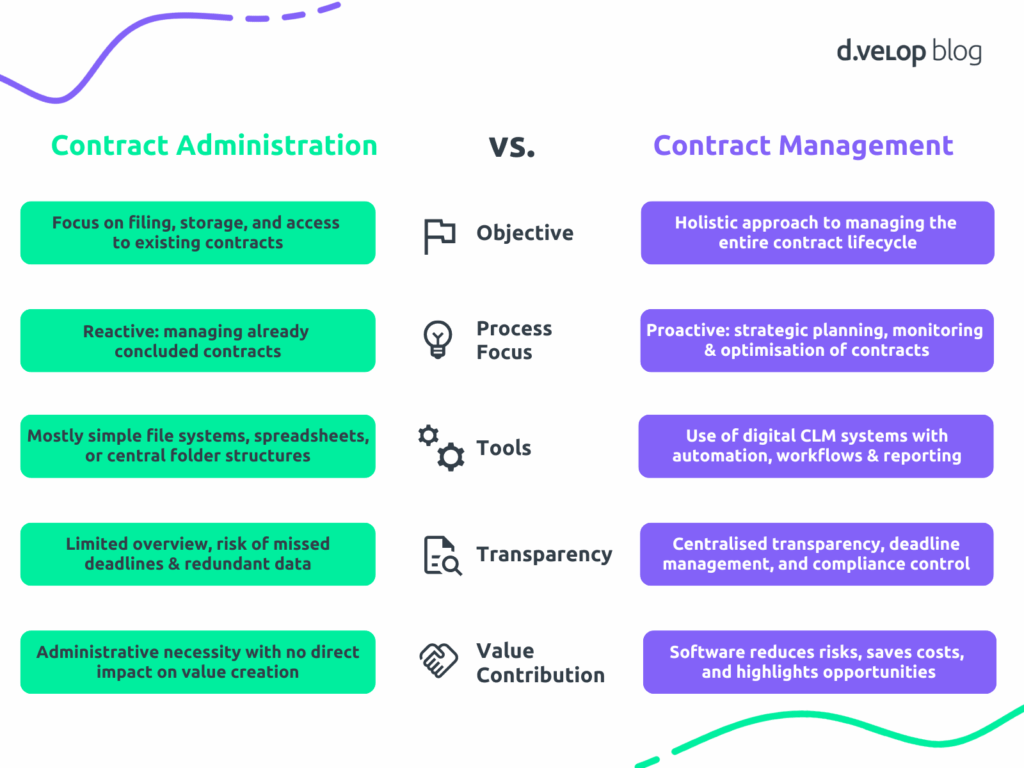
An effective contract management process goes far beyond simple contract administration. While contract administration primarily covers the filing and retrieval of existing contracts, the contract management process encompasses the entire lifecycle of a contract – from creation, negotiation, approval and digital sign-off through to renewal or termination.
In a traditional administrative approach, tasks such as archiving or deadline monitoring are the main focus. A well-designed digital contract management process, however, uses modern tools and automated workflows to streamline processes, minimise risks and generate valuable insights from contract data.
Whereas contract administration is largely reactive and administrative, contract management is proactive, data-driven and value-creating. Organisations that recognise and implement this distinction transform their contracts from a mere administrative duty into a genuine competitive advantage.
Contract management process digitalised – How it works at edding AG
As with many processes, the same applies to the contract management process: go digital! A software solution enhances the contract management process and can also trigger additional processes and workflows. edding AG has recognised this for its own contract processes. With the d.velop contract management software and digital signature, the company was able to reduce the time required for contract processing and signing from 4–5 days to an average of just 5 minutes.
- d.velop contracts for M365 in use across the entire contract lifecycle
- Integration of the software into the existing Microsoft 365 environment
- d.velop sign used nationwide for contract signing
- Processing times significantly reduced
- Manual processes replaced by digital, automated workflows
What excites me about the solution is that it is the first time we have a standard product that can then be adapted to the company and its needs. We can add new features and, as in our case, integrate the digital signature so that it fits seamlessly into our way of working.
Alina Drechsel
Digital Consultant, edding AG