

Planning your holidays from the comfort of your sofa in the evening, checking hotels and submitting a digital leave application sounds ideal, doesn’t it?
In reality, however, many organisations still operate very differently. An employee plans their holiday and feels excited, only to realise that they still need to fill in and submit a leave request on paper.
That means printing the form, filling it in, signing it and then passing it on to the line manager for approval, followed by HR. In the meantime, several questions arise:
- Are the remaining leave days correct?
- Has the employee filled in all values accurately?
- Who will cover their tasks during the absence?
This level of manual coordination increases the likelihood of errors and leads to unnecessary follow up communication. And that is not all. In many cases the form must even be reprinted, corrected and signed again. As a result the employee’s holiday booking is delayed and the preferred hotel or special offer may no longer be available. For HR, managers and staff alike this outdated paper based process is frustrating, time consuming and ultimately wasteful.
This blog article explains how a digital leave application can be implemented quickly and efficiently in any organisation and why it benefits everyone involved.
Digitalisation of HR processes
The digitalisation of business processes has increased significantly in recent years, and this development also includes workflows within Human Resource Management. HR processes refer to complex tasks carried out within the HR department that contribute directly to organisational success.
The current situation
The level of digitalisation in HR is often closely linked to the overall digital maturity of an organisation. In a study conducted by aconso and the Hochschule Niederrhein, 50.5 per cent of respondents stated that there are still no automated administrative processes within their organisation. Conversely, this means that 49.5 per cent already work with digital processes. But which HR processes are currently being automated the most? The top three are time recording with 68.9 per cent, the leave request process with 55.6 per cent and paperless payroll with 51.1 per cent. We have already taken a closer look at digital payroll delivery in our blog article “Classic versus digital payroll. Is there a difference”.
How does long term planning look in HR departments? When asked when full automation will be achieved, the largest group at 21.5 per cent estimated that it will take another three to four years. Around 20 per cent even stated that full automation has no relevance for their HR department and is therefore not part of their long term strategy.
Advantages derived through process automation
Why do so many companies resist when the advantages are patently obvious? As in all areas of an organisation, the digitalisation of processes within the HR department, such as implementing a digital leave application, offers a wide range of advantages.
One of the biggest benefits is the potential for cost and time savings. These arise from shorter processing times and the automated monitoring of contract deadlines.
In addition, digitalisation helps simplify workflows. This enables HR professionals to focus on value creating tasks that require human understanding and specialised knowledge.
Furthermore, studies indicate that the digitalisation of HR processes increases employee satisfaction and enhances an organisation’s attractiveness as an employer.[1]
- Cost and time savings
- Simplified workflows
- More time for value creating tasks that require human understanding and expertise
- Higher employee satisfaction and greater attractiveness as an employer
- Designing simple processes in a digital way
The digital leave application as an introduction to digitalisation
It doesn’t have to be full automation. It is also possible to start with small steps and automate simple (sub-)processes.
When digitising the leave application, the use of DMS can be the starting point for digitising other processes in the company. This doesn’t just apply to the human resources department, where a digital personnel file is conceivable, for example. Also in accounting (e.g. in the context of digital invoice processing, in contract management and general digital file management towards a paperless office.
Digital personnel files for the age of remote working
The digital personnel file is an essential part of modern HR management.
By introducing a digital leave application, time and money can be saved, whilst at the same time creating a high level of transparency.
Introduction of a digital leave application
The first step in digitising the leave application is defining a process model. The roles and responsibilities of all those involved and their representatives are crucial for the digitalisation and automation of the process model. This means the leave application process can be processed digitally.
Using a form that is integrated into the intranet or company portal, for example, all employees can fill out their leave application. Processing can take place via a document management system, which forwards the applications to the responsible person using a workflow. This means that the supervisor receives an immediate notification when an employee has submitted a leave request. Criteria for checking and approval are also stored in the workflow, making the decision easier for the supervisor.
The digital leave application with d.velop documents
With the d.velop document management system d.velop documents, you can digitalise the submission of a leave request by using a simple form and design the process so that it is presented digitally to both the line manager and the HR department.
In the video below I demonstrate how a digital leave application can be set up within just a few minutes.
Everything in one place: The digital leave application via app
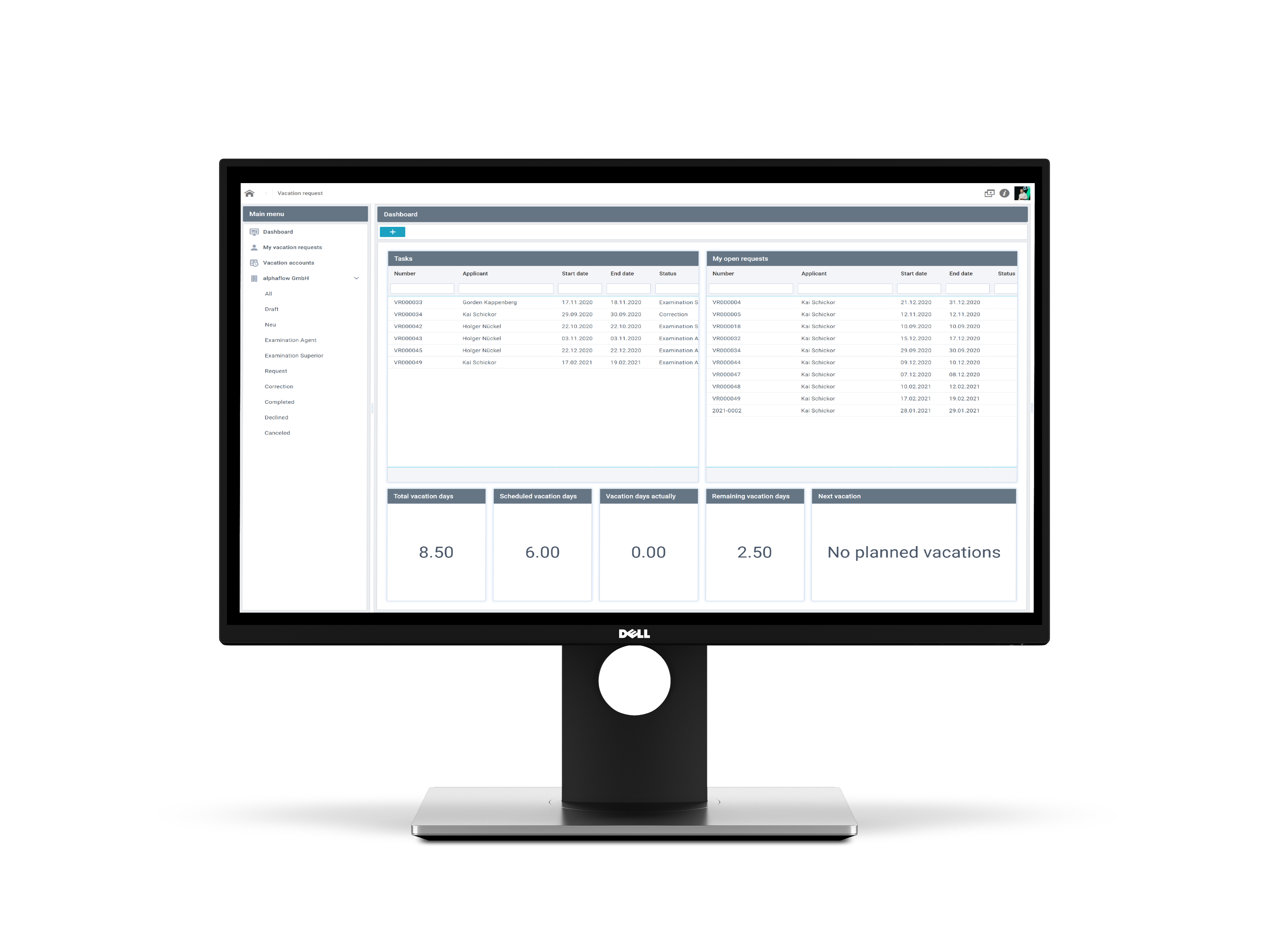
Of course, the digital leave application can also be submitted using the d.velop App Builder alphaflow leave application app.
With the leave application app you can not only map the entire approval process in a digital way but also benefit from a clear and intuitive dashboard. This allows you to view open tasks, your own requests and your taken and remaining leave days at a glance. You can also manage leave accounts, special leave and public holidays, giving you a complete solution at the touch of a button that adapts perfectly to your individual requirements.
Advantages of the digital leave application
The digitalisation of HR processes already offers organisations a number of advantages. However, digital leave planning on its own provides significant added value for employees, HR departments and the entire organisation.
- More transparency
- No paper chaos
- Shorter processing times
- Lower costs
Paper chaos, lost leave applications or verbal approvals are a thing of the past. Thanks to the digital leave application, every employee can see the current status of their request. By checking the dashboard, they can immediately view whether their application is approved, in progress or rejected. Processing times are also significantly reduced.
Managers gain an instant overview of which employees are on leave. A clear display of remaining leave days also provides planning certainty regarding team availability. Employees benefit from automated services, avoiding manual leave calculations and receiving notifications for all actions.
Clearly defined workflows and role assignments within the system support any necessary adjustments, for example when annual leave entitlement changes.
Finally, costs are reduced as well. Savings include printing, paper and filing, as well as time. Both HR and managers benefit from shorter processing cycles. Employees no longer have to wait unnecessarily for approval of their leave application, which ultimately increases overall satisfaction.
💻Book Software Demo
Experience the power of d.velop’s software with a personalised live demo, easily requested with just a few clicks. Watch as the software comes to life before your eyes and ask any questions you may have in real-time.