

When we look back in 2026 at the previous 24 months, it feels as though we have lived through a decade of technological evolution in fast-forward. Yet the real shift this year is no longer defined by the breathtaking speed of new models, but by the maturity with which we apply them.
The era of pure fascination is behind us. Organisations have learned the hard way that artificial intelligence alone does not deliver digital transformation. Automation remains the engine, AI the turbocharger – but even the most powerful drive is useless if the chassis cannot support it. Value is created where technology simplifies processes, prepares decisions, and relieves people without stripping them of responsibility.
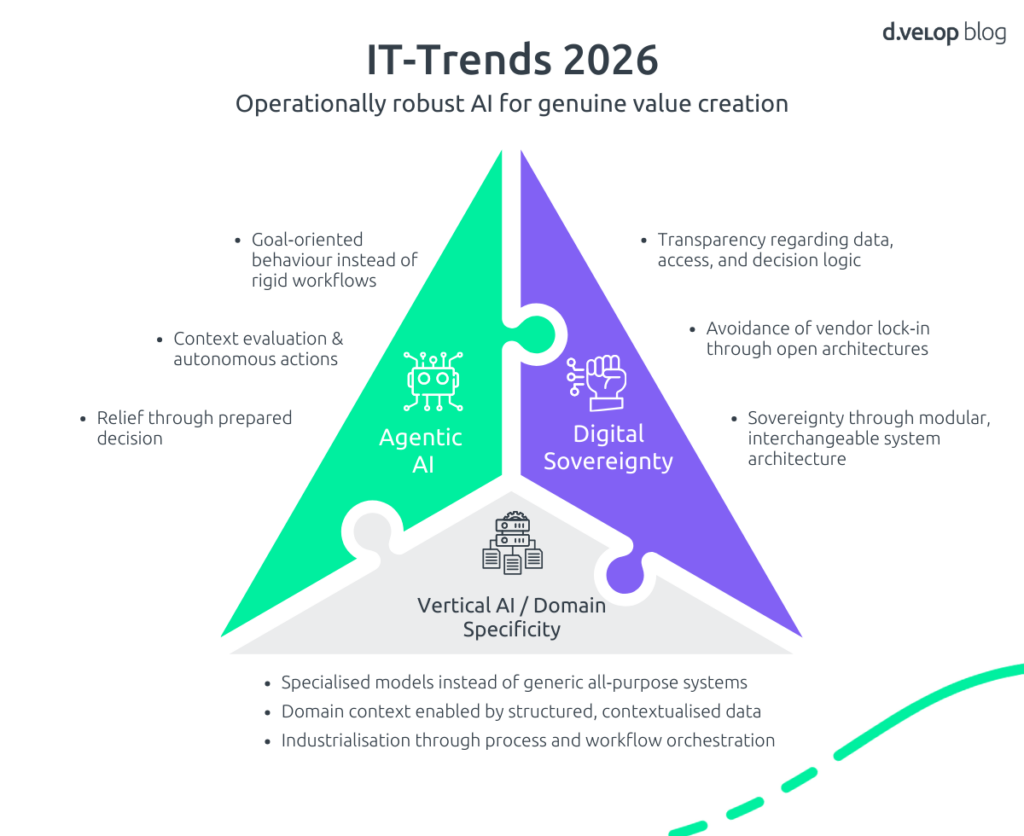
For that reason, 2026 does not mark yet another hype cycle, but a fundamental transition: away from the question “What is theoretically possible?” towards “What is operationally viable?”. As the CTO of a company that has been digitising processes for decades, I see three developments shaping this year. Each is significant on its own, but it is their convergence that unlocks genuine value creation. Discover the IT trends of 2026:
IT-Trend No. 1: Agentic AI
Rethinking automation: from workflow to agent
For a long time, automation was synonymous with rigidity: we built digital assembly lines driven by simple if‑then rules. These models are excellent for standardised processes, but they fail when confronted with the reality of complex office work full of exceptions and contextual dependencies.
In 2026, we are witnessing the breakthrough of agentic AI.
“Agentic” does not simply mean “smarter”. It represents a paradigm shift in software architecture. While traditional workflows wait for a trigger, AI agents pursue goals. They identify relationships, evaluate situations in the context of the underlying documents, and autonomously initiate next steps – traceable, compliant, and controlled.
Think of it like this: A workflow forwards an invoice for approval. An agent compares the invoice with the delivery note, detects a discrepancy, drafts a query to the supplier in the company’s tone of voice, and passes only the decision‑relevant difference on to the clerk.
The real progress lies in genuine relief. Agents take over routine decisions, coordinate processes, and prepare actions. Humans remain in charge, but they work with systems that think ahead.
Forrester refers to this as “agentic readiness”. In 2026, organisations are no longer measured by whether they use AI at all, but by how effectively they embed these autonomous systems into their governance structures – with clearly defined decision spaces, transparent traceability, and regulated human intervention capabilities.
Shaping the Future with AI-based Content Services
- AI-driven document recognition and content analysis
- Chat-based responses to complex queries
- Intelligent process automation combined with d.velop process studio
IT-Trend No. 2: Vertical AI and Domain Specificity
Generative AI: Beyond the hype, industrialisation begins
Is generative AI a bubble? Anyone still asking this question in 2026 has missed the development entirely. We are – to stay in Gartner’s terminology – well beyond the “valley of disillusionment” and firmly on the “path of enlightenment”.
The experimentation phase of 2024/2025 was necessary, but often sobering. Many pilot projects failed. Not because of the technology, but due to a lack of context, unclear responsibilities, or an insufficient data foundation. A language model that knows the entire internet but does not understand your company’s specific terms and conditions or project files is, in a business context, a brilliant rhetorician without subject‑matter expertise.
The 2026 trend is therefore Vertical AI and Domain Specificity.
We are shifting away from generic “do‑everything” models towards specialised systems that are deeply trained within a specific professional domain. This is where the concept of data gravity becomes crucial: business value emerges where AI meets structured, contextualised data. Those who maintain their information cleanly within a DMS hold the very foundation that enables Vertical AI to work at all.
Tools for orchestrating complex automation and AI workflows – whether flexible platforms like n8n or specialised environments such as our d.velop process studio – are becoming the central control units. They connect the raw intelligence of the models with the logic of business processes. In doing so, AI evolves from an exotic experiment into a reliable component of everyday operations.
IT-Trend No. 3: Digital Sovereignty
The sovereignty paradox: openness through control
All these advancements – autonomous agents, deep process understanding – require something that, in 2026, is more valuable than computing power: trust.
Digital sovereignty is no longer a political buzzword but a strict architectural requirement. The more decisions we delegate to agents, the more essential it becomes to know where data resides, who has access to it, and how the decision‑making logic works.
We are observing an interesting market shift. The major US hyperscalers are building extensive “Sovereign Cloud” offerings for Europe. This is an acknowledgement that the European market operates under different rules. Yet genuine sovereignty means more than simply running a data centre in Frankfurt. It means avoiding Vendor Lock‑in at the model level.
This is why Open‑Source Models and open architectures are gaining strategic relevance. They allow us to benefit from the innovation of global platforms without relinquishing control over our digital identity. For Agentic‑AI scenarios in particular, where multiple systems interact autonomously, this openness is crucial. European initiatives such as Mistral AI and STACKIT demonstrate how sovereign, open ecosystems can be built – even if their investments are still limited in global comparison and they remain dependent on international supply chains.
For 2026, the principle is: sovereignty through architecture.
The real trend therefore lies less in individual technologies and more in architectural decision‑making. AI, agentic AI and automation only unfold their full value where organisations are willing to embed sovereignty into their thinking – in the choice of platforms, the use of open source, and a conscious approach to global dependencies. Digital sovereignty thus becomes the connecting element of modern IT strategies and a decisive factor for sustainable, AI‑driven transformation. Accordingly, we must build systems that are modular enough to allow the underlying AI model to be replaced without jeopardising the business process.
Conclusion: Continuity as a Strength in Times of Change
For us at d.velop, these trends – agentic AI, vertical AI, and sovereignty – do not represent a break with the past, but rather the logical evolution of what we have been doing for nearly 35 years.
We have always operated at the intersection of expertise, processes, and regulatory requirements. Whether in the private sector or the public sector, in healthcare or finance: the challenge was never merely the storage of documents, but the understanding of their content.
A crucial component of this stability is the topic of digital sovereignty. Our technological focus on open‑source‑based infrastructures, and the fact that the essential products and intellectual property remain in our own hands, give both us and our customers freedom of design. They reduce dependencies, increase transparency, and enable the controlled and responsible use of new technologies such as AI and agentic AI.
The real treasure, however, does not lie in the technology alone, but in the long‑standing collaboration with our customers. We have always approached expertise, processes, and regulatory realities together. Now it is time to combine this experience with new technological possibilities.
2026 will be the year in which we stop marvelling at technology as an end in itself and begin using it as a tool for human‑centred work. The tools exist. The data exists. What matters now is applying them with sovereignty.