SAP HCM in Transition – Shaping the Future with SAP SuccessFactors and HXM

Published December 18, 2025

Laura Funke Online Marketing Manager d.velop

Human Resource Management in companies is one of the areas with the greatest automation potential. In particular, recurring HR processes can now be handled almost entirely by software. However, digitalisation in HR today goes far beyond mere automation. This was also confirmed by Prof. Dr Peter M. Wald, Professor of Human Resource Management at HTWK Leipzig, in an interview:

In future, there will hardly be any tasks in the HR context that can be managed without digital tools. […] HR must be aware that today and in the future it stands at the intersection of technology, organisation and people – and is required to act as a designer and provider of solutions.

Prof. Dr Peter M. Wald
Professor of Human Resource Management
HTWK Leipzig

A typical HR day clearly illustrates this transformation: whereas personnel files used to be archived in paper form, digital solutions now enable comprehensive, cloud-based management – including intelligent assistance. But HR is no longer limited to managing data and documents with a traditional Human Capital Management (HCM) system; the employee experience is becoming increasingly important.

The software provider SAP offers SAP SuccessFactors, a powerful, cloud-based Human Experience Management (HXM) solution for the new core topics in corporate HR. The solution is designed to gradually replace traditional HCM systems such as SAP HCM, which has so far been widely used for personnel administration and payroll.

The shift from classic HCM systems to modern HXM platforms like SuccessFactors shows that HR is evolving from a pure administrator to an active shaper of the working world. In this blog post, we explain why SAP HCM is being replaced, the role SAP S/4HANA plays, the advantages of SuccessFactors, and how the move to HXM is transforming HR management for the long term.

What is SAP HCM – and why is now the right time for change?

Definition of SAP HCM

SAP HCM is an integrated software solution for human resources and personnel administration. It offers a wide range of functions for managing employee information, payroll, time and talent management, as well as performance evaluation. SAP HCM is a tool used by organisations to optimise HR processes. It helps automate workflows and makes managing employees and their data more efficient. HCM is part of the comprehensive SAP ERP system and can be seamlessly integrated with other SAP modules.

End of Maintenance for the SAP HCM Solution

The HCM software maps the company’s hierarchical structures and enables employee management and development. As a long-standing on-premise standard solution, SAP HCM is now being gradually phased out.

Standard maintenance for SAP ERP and SAP HCM will end on 31 December 2027. Extended maintenance will be available until the end of 2030. This means regular checks and updates of the software will cease – including bug fixes, patches, security updates and new functionalities. But what comes after SAP HCM?

SAP S/4HANA as a Bridge Between SAP HCM and SAP SuccessFactors

SAP HCM will be supported until the end of 2030, but it is being discontinued. With the end of maintenance for SAP ECC 6.0, all existing HCM customers are required to consider an appropriate successor solution.

As a technical successor, SAP provides H4S4 (SAP HCM for S/4HANA) – a new HCM component based on SAP S/4HANA, although without talent solutions.

Before the introduction of H4S4, companies could use SAP HCM functionalities via the so-called SAP S/4HANA Compatibility Pack. This was a transitional solution, supported only until the end of 2025, which allowed the classic HCM from the Business Suite to continue running on older S/4HANA versions.

The Transformation: From HCM to HXM in SAP SuccessFactors

Definition: SAP SuccessFactors and HXM

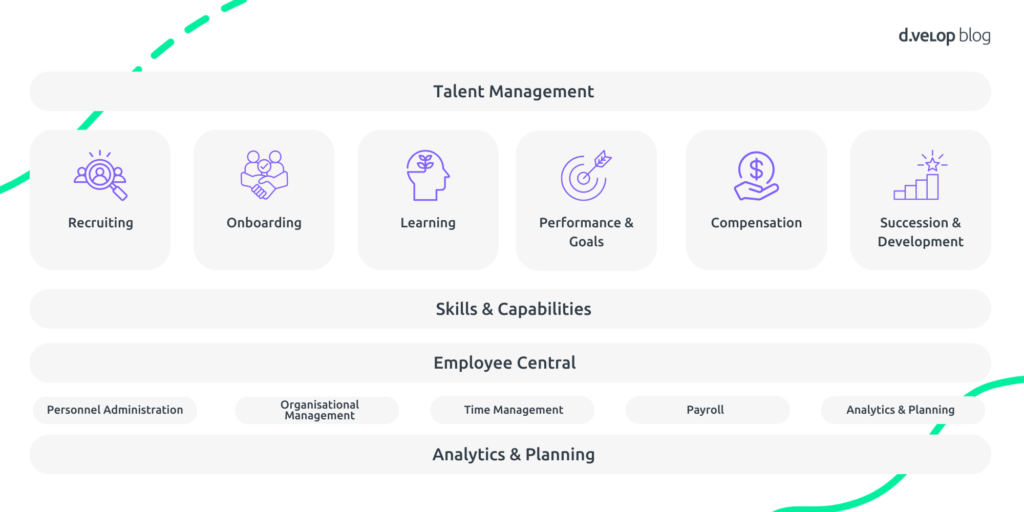
SAP SuccessFactors is a cloud-based HXM software solution for human resource management. It includes a wide range of core HR functions in areas such as recruiting, onboarding, performance management, goal management, competency management, payroll and training. The software helps organisations improve their HR processes and employee performance. SAP SuccessFactors can be seamlessly integrated into existing company systems and offers flexible adaptation to organisational needs and requirements.

According to the SAP roadmap, SAP SuccessFactors is intended to eventually replace both the classic SAP HCM and the transitional solution H4S4. For now, however, H4S4 remains relevant: SAP has committed to maintenance until at least the end of 2040 – currently a 15-year horizon.

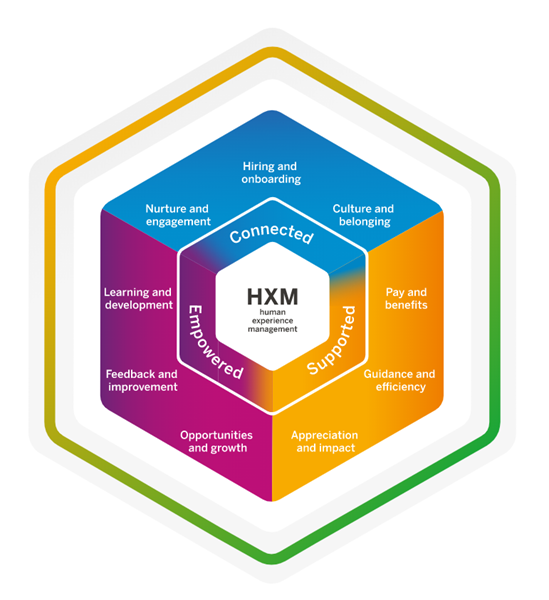
At the heart of HXM, HR management focuses more on employee experiences such as wellbeing, learning and collaboration rather than just HR processes. Dr Wald also emphasises this concept of HXM in his interview on digitalisation in HR management:

The workplace of the future offers […] new spaces for creativity, diverse communication and learning opportunities […] as well as initiatives to maintain and promote physical and mental health.

Prof. Dr Peter M. Wald
Professor of Human Resource Management
HTWK Leipzig

Deployment Models for SAP SuccessFactors

SAP offers four different deployment models for the SuccessFactors HCM Suite, which organisations can choose based on their starting point and objectives:

  • Talent Hybrid: SAP HCM or H4S4 remains in use for core processes, while SuccessFactors is used for talent management modules such as recruiting, onboarding and learning.
  • Side-by-Side: SAP HCM/H4S4 and SuccessFactors Employee Central run in parallel. Depending on the employee group, either HCM/H4S4 or SuccessFactors acts as the master data system.
  • Core Hybrid: SuccessFactors Employee Central becomes the master data system. Data is synchronised with SAP HCM or H4S4, where payroll and time management continue.
  • Full Cloud HCM: The entire SuccessFactors HCM Suite, including Employee Central Payroll, is used. This option is primarily suitable for new SAP customers without existing on-premise payroll systems.

The Core Hybrid Model Prevails

Although SAP SuccessFactors covers many modern HR functions, it currently does not offer a fully comprehensive solution for the complex payroll requirements in the DACH region. For this reason, many organisations opt for a hybrid approach, using H4S4 for payroll and SuccessFactors for talent management.

This scenario represents the most widely adopted Core Hybrid Model, where SuccessFactors is used for recruiting, onboarding and master data management, while payroll continues to be handled via SAP HCM or H4S4.

HCM and SuccessFactors: What Are the Differences?

Organisations looking to future-proof their HR processes are increasingly turning to SAP SuccessFactors – often in combination with the existing SAP HCM solution for as long as it remains supported. Both systems complement each other well. But what are the main differences between the two? The following overview provides clarity:

  • Architecture: SAP HCM is an on-premise solution, whereas SuccessFactors is cloud-based.
  • Functionality: SuccessFactors offers a broader range of functionalities for talent management processes, such as performance management, goal setting, learning and development. SAP HCM, on the other hand, focuses more on traditional HR management processes.
  • User Interface: SuccessFactors provides a more modern, user-friendly interface compared to SAP HCM.
  • Configurability: SAP SuccessFactors is easier to configure and maintain but quickly reaches its limits with complex requirements and custom extensions. SAP HCM offers significantly more flexibility through backend access and ABAP development, but this requires technical expertise and is maintenance-intensive.
  • Integration: As a cloud-based solution, SuccessFactors can be integrated more easily with other cloud applications. SAP HCM is primarily designed for integration with on-premise systems.
  • Upgrades: SuccessFactors receives automatic cloud updates, whereas organisations must carry out upgrades themselves with SAP HCM.
  • Data Analysis: SAP SuccessFactors provides more extensive options for data analysis and reporting than SAP HCM.

Strengths of SAP HCM – The Backbone of HR Processes

SAP HCM is a software solution that supports organisations in managing and developing their workforce. Its benefits range from process automation to improving employee satisfaction. Specifically, this means:

  • Centralisation: SAP HCM enables centralised management of all HR-related data within an organisation, including employee information, payroll, performance reviews and more.
  • Efficiency Gains: Automating HR processes such as absence management, employee evaluations and payroll allows HR to work faster, more efficiently and strategically. It also reduces the workload by eliminating time-consuming, repetitive tasks.
  • Improved Decision-Making: Collecting and analysing data in SAP HCM makes it easier for managers to make informed decisions. For example, performance data can help identify training needs or adjust salary structures.
  • System Integration: SAP HCM can be seamlessly integrated with finance and procurement systems, enabling holistic evaluation of company data.
  • Compliance: Human Capital Management helps HR comply with legal requirements in personnel administration, such as reporting obligations and data protection regulations.

Given these strengths, SAP HCM has been and remains a proven solution for administrative HR processes. However, with the end of maintenance and the need for future-oriented HR management, organisations face the challenge of adapting their HR systems for the future.

Advantages of SAP SuccessFactors – The Modern Cloud Alternative

SAP SuccessFactors is considered one of the leading cloud solutions for Human Capital Management. Organisations using it benefit not only from automation and optimisation of HR processes. SuccessFactors puts people and user experience (UX) at the centre, improving efficiency, boosting productivity and enhancing employee engagement. Examples of its advantages include:

  • Cloud-Based: Unlike HCM, SuccessFactors is cloud-based. Employees can quickly and remotely access the system and, for example, view their digital personnel file in SAP without additional IT infrastructure. Moreover, organisations can offer employee self-services: requesting leave, submitting sick notes – all digitally and via mobile. Maintenance and updates in the cloud run automatically.
  • HR Management: SAP SuccessFactors supports a wide range of strategic HR tasks, including talent management, recruitment, performance management, learning and development, and compensation management.
  • Data Security: Data is stored in dedicated SAP data centres, with access via encrypted connections. Data protection in HR and GDPR compliance are top priorities.
  • Flexibility: SuccessFactors is a flexible solution that can be tailored to the individual needs and requirements of any organisation.
  • Data Analysis: Extensive analytics functions help organisations gain valuable insights from HR data and make informed decisions. For example, the software can automatically suggest project teams that work well together based on data.
  • Artificial Intelligence: The HR software uses AI technologies such as machine learning, natural language processing (NLP), predictive analytics and AI-based automation to improve recruiting, onboarding, performance management and talent management.
  • User-Friendliness: The interface is intuitive and easy to use, enabling employees and managers to access the system quickly without extensive training – even via mobile app.
  • Integration: The software integrates seamlessly with other IT systems to ensure smooth and effective data transfer and utilisation.

Although SAP HCM has long been a stable solution for traditional HR processes, the comparison with SAP SuccessFactors clearly shows how HR requirements have evolved. The advantages outlined above demonstrate why SuccessFactors, as an HXM platform, represents the future of HR.

Further Development of SAP HCM: Artificial Intelligence in HR Management with SAP

The classic SAP HCM solution did not include artificial intelligence (AI). This only became possible with the cloud-based variant.

The HR software SAP SuccessFactors uses AI technologies such as machine learning, natural language processing (NLP), predictive analytics and AI-based automation. These help automate and improve processes such as recruiting, onboarding, performance management and talent management by making decisions based on data and analysis. In addition, AI reduces the workload for employees and gives them the feeling of being well supported.

One key enhancement is Joule, SAP’s generative AI assistant, which makes SAP SuccessFactors even more powerful. Joule simplifies and personalises interaction with SAP systems. Through a conversational interface, users can easily retrieve information (e.g., salary data, team structures), perform tasks (e.g., holiday requests, address changes) and navigate the system without clicking through menus. Joule complies with European data protection standards while understanding context, processing multiple pieces of information simultaneously and delivering precise, data-driven answers.

d.velop and SAP

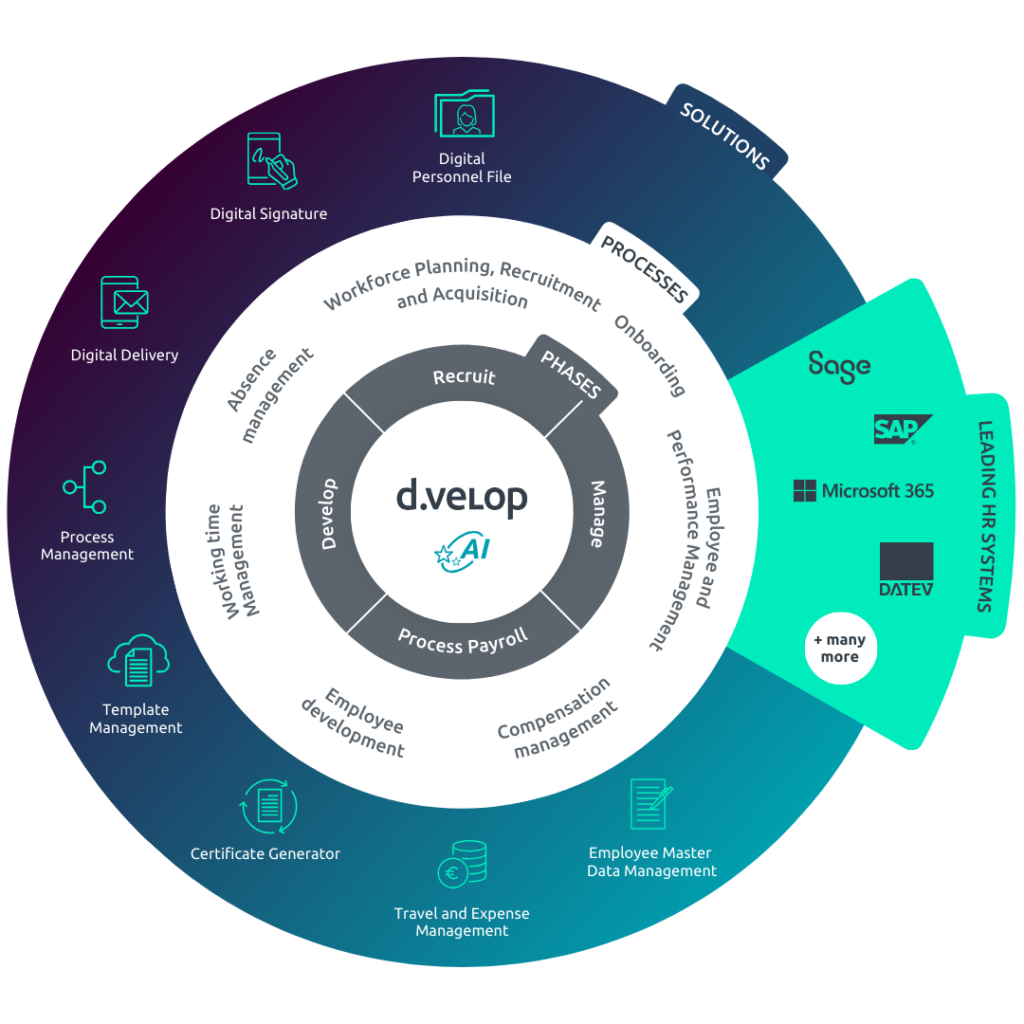
As a software provider, d.velop offers an interface to SAP SuccessFactors and SAP HCM/H4S4, enabling direct integration of its document management system, d.velop documents for SAP. This allows HR departments to work with digital personnel files and other useful digital features.

An SAP-integrated DMS with a legally compliant digital archive can serve as a central knowledge repository and boost the productivity of both systems. This combination enables future-oriented development of HR processes within organisations. Our dedicated SAP team of experienced consultants and developers supports companies in implementing, customising and enhancing the interface.

Creating Smart HR Processes with SAP

HR processes consume more resources the less automated they are. HR software such as SAP HCM and SAP SuccessFactors provides relief, particularly for repetitive tasks. Both solutions offer unique advantages: HCM excels in traditional HR areas, while SuccessFactors stands out with cloud technology, strategic HR management and AI integration. Combined with a document management system like d.velop documents for SAP, including a secure digital archive, both systems become even more productive and capable of driving sustainable HR transformation.

Software Demo for Our SAP Solutions 💻

Book your personalised software demo with just a few clicks and experience our digital SAP solutions live. Ask your questions directly to our experts.

Case Study: HR Digitalisation at GRIMME Agricultural Machinery

GRIMME has relied on d.velop as its digitalisation partner for more than 10 years. With 37 locations worldwide, the GRIMME Group is an international manufacturer of agricultural machinery for potato, beet and vegetable technology. With over 150 machine types and sales in more than 120 countries, GRIMME is one of the leading providers in this segment.

By integrating SAP SuccessFactors into d.velop documents, GRIMME has created efficient and modern HR processes for around 2,300 employees.

We have been working closely with our partner d.velop AG for almost 20 years to drive digitalisation within the company. This interface is another building block to optimally combine our DMS landscape with other systems.

Jens Waldmann
Team Lead IT – Enterprise Information Management
GRIMME Landmaschinenfabrik GmbH & Co. KG

Before introducing SAP SuccessFactors, many HR processes at GRIMME were paper-based and manually organised, which was not only time-consuming but also prone to errors and inefficiencies. The implementation of SAP SuccessFactors enabled GRIMME to modernise HR processes comprehensively by digitising workflows and significantly improving efficiency.

Integrating SAP SuccessFactors with d.velop documents allowed GRIMME to transfer HR documents seamlessly and automatically into the document management system, reducing paper consumption, speeding up information availability and improving data security.

A major advantage: the existing digital personnel file in d.velop documents could be connected to SuccessFactors with minimal effort – a model particularly suitable for companies still using HCM and planning the transition to SuccessFactors.

Smart HR Processes with SAP – A Meaningful Evolution

HR processes consume more resources the less automated they are. Solutions such as SAP HCM, H4S4 and especially SAP SuccessFactors provide relief and reduce the workload for HR teams, particularly for repetitive tasks.

Each system has its strengths: SAP HCM and H4S4 excel in traditional HR areas, while SuccessFactors, as the successor, represents the future of HR with cloud technology, strategic and employee-centric HR management, and AI integration.

A Few Steps to Automated Procure-to-Pay Processes in SAP

Gain insight into what a digital procurement process looks like and its benefits over the traditional process.